
For months, scientists and the public have squinted their eyes at photos of a blurry smudge to figure out if it’s proof that aliens exist.
Discovered in July, 3I/ATLAS is not your average comet – it’s a giant snowball from beyond our solar system.
The comet, earlier known as A11pI3Z, passed by us in December. It’ll do a pit-stop at Jupiter in the spring before heading back out into the abyss.
Harvard astrophysicist Avi Loeb is one of the biggest proponents of the theory that the comet was sent by an alien intelligence.
Loeb has repeatedly pointed to odd things that 3I/ATLAS has done, such as exhibiting ‘jet thrusters’ or changing colour.
Now scientists have revealed the results of a dedicated scan for signs of radio-transmitting technology in the object.
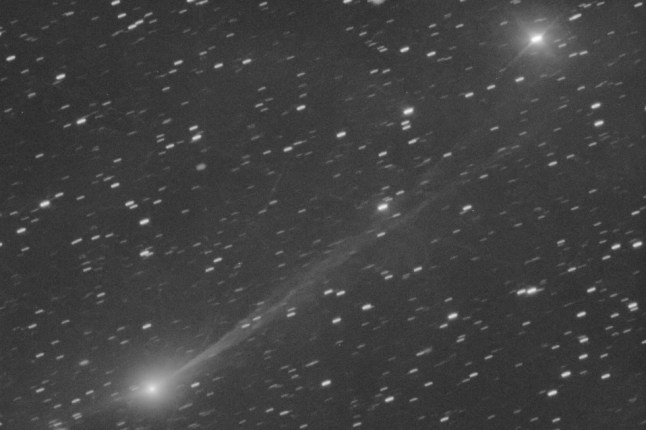
A team from Oxford’s alien-hunting astronomy group, the Breakthrough Project, pointed one of the world’s largest radio telescopes at 3I/ATLAS.
In a new paper, published in Research Notes of the American Astronomical Society, the team said the Green Bank Telescope failed to pick up any ‘candidate signals’ on December 18.
This was when the comet was nearly 170 million miles away from Earth.
Signals were detected but none were artificial technosignatures, which would indicate technology on or in the comet.
The researchers concluded: ‘3I/ATLAS exhibits mostly typical cometary characteristics, including a coma and an unelongated nucleus.’
They admit that more research on interstellar objects is needed, given we’ve only observed three so far.
Is the radio silence proof that the comet was not an alien probe?
It depends on who you ask. Loeb told Metro that he is undeterred by the results, given that he encouraged Project Breakthrough to study the object.
He said that the direction 3I/ATLAS came from was roughly where the ‘Wow!’ signal was detected.
The anomaly was a 72-second radio burst in 1977 that has never been explained – the astronomer who noticed it jotted ‘wow!’ next to the result.
Loeb said: ‘It is unclear whether a technological object would transmit radio signals to its senders because such signals would take tens of thousands of years to cross the Milky Way galaxy.
‘Whereas the time that it spends inside the solar system, all the way to the edge of the Oort Cloud, is only 16,000 years.
‘Moreover, any such signal may not be transmitted in the direction of Earth or at the frequency band or date that were monitored.’
To view this video please enable JavaScript, and consider upgrading to a web
browser that
supports HTML5
video
Mark Christopher Lee, a UFO expert, said he agrees with Loeb’s conclusions.
‘This negative result only rules out certain types of transmissions, specifically, those resembling our own radio technology at relatively low power levels,’ the filmmaker told Metro.
‘Advanced extraterrestrial intelligence, if it exists, might employ entirely different communication methods, such as directed laser beams, quantum signals, or even no emissions at all if the object is a dormant probe.
‘Absence of evidence is not evidence of absence.’
For astrophysicist Dr Alfredo Carpineti, however, comet 3I/ATLAS is just that, a comet.
The space correspondent for IFLScience said: ‘A crucial aspect of science is performing observations over and over again to be as certain as we possibly can.
‘The “alien hypothesis” was never backed up by any data… but it is great to get telescopes to show, time and time again, that this interstellar interloper has nothing artificial going on.’
Get in touch with our news team by emailing us at webnews@metro.co.uk.
For more stories like this, check our news page.