A legal ‘blind spot’ may prevent Ofcom from protecting people after Grok ‘undressed’ hundreds of people on Elon Musk’s X.
Users can make image-generation requests by tagging Grok’s X account when replying to a person’s post, even if it is not their photograph.
Women have told Metro that the chatbot, powered by artificial intelligence (AI), has placed them in bikinis or ‘undressed’ them without their consent.
The media regulator Ofcom has since confirmed to Metro that it is in ‘urgent talks’ with X and xAI, the AI start-up behind Grok.
Under the Online Safety Act (OSA), a bill that regulates online material, it is illegal to create or share intimate or sexually explicit images.
Social media companies must take steps to prevent harmful content on their platforms or else face fines from Ofcom.
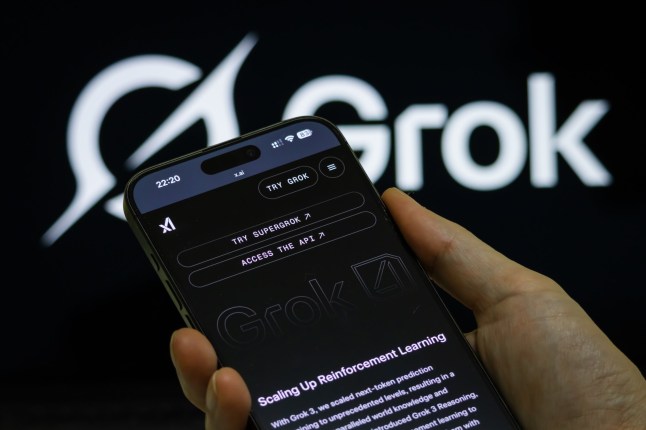
After posting the statement on X, a user asked Grok to place the Ofcom logo in a bikini – the virtual assistant complied.
Yet the Centre for Policy Studies questioned whether Ofcom can go far enough to protect users.
The think-tank’s communication and digital manager, MeIisa Tourt, said Grok forging non-consensual images is outside the scope of the law.
‘The OSA’s remit is strictly limited to user-to-user and search services, meaning it does not regulate AI models themselves until their output is shared,’ she told Metro.
‘To complicate matters, the OSA mandates that platforms treat “bots” as normal users, meaning that while a human might prompt a deepfake, the legal act of “sharing” is often performed by the platform’s own @Grok account.
‘This creates a regulatory blind spot that Ofcom may struggle to navigate with current enforcement tools.’
Tourt added that the law is murky around ‘deepfakes’ as it excludes images that show something ‘originally seen in public’, such as a bikini.
‘We risk ending up in a bizarre situation where posting a real non-consensual image of someone in a bikini is legal, but generating a fake one could theoretically carry a two-year prison sentence,’ she said.
Sexualised deepfakes ‘amount to a serious breach of privacy’
Grok is a type of generative AI that ingests information from datasets to learn patterns of how humans write, make images and film videos.
Clare Veal, a commercial solicitor at the Surrey-based firm Aubergine Legal, told Metro that AI tools like Grok don’t have a ‘moral judgement’.
‘That’s why platforms have a legal and ethical responsibility to build in guardrails,’ she said.
'It made me feel exposed and powerless'
Among those who say users have asked Grok to create phoney images of them is Ruben Chorlton-Owen, a content creator from Wales.
He told Metro: ‘Some of my photos from Instagram have been used by AI to create bizarre and sexualised images of me in outfits I never agreed to, including “transparent outfits” and other dodgy combinations.
‘These images were often forwarded to me by others, which was both unsettling and surreal.’
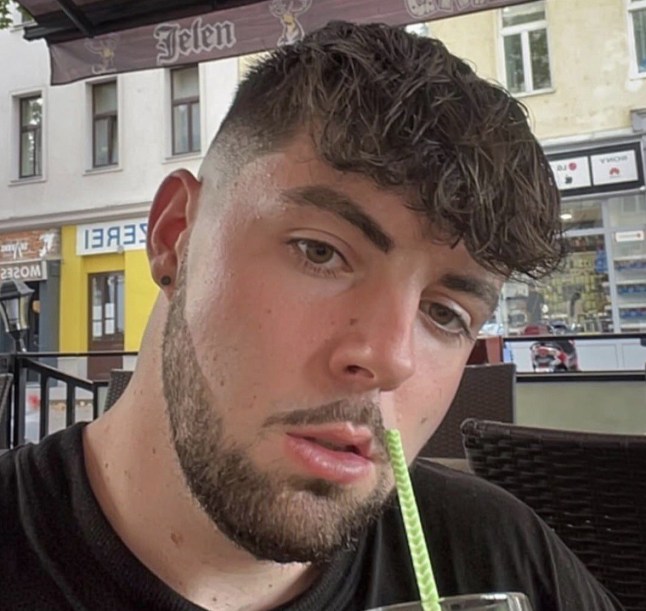
In one exchange seen by Metro, a troll asked Grok to strip Ruben, with the bot making a synthetic image of the musician shirtless.
Under xAI’s acceptable use and privacy policies, users are prohibited from creating or sharing content that harms people.
But Ruben, 24, questioned whether X’s policies were robust enough.
‘It made me feel exposed and powerless, and highlighted how little control people have over their own images once online and myself as a content creator, whose photos are already accessible,’ he added.
‘When an AI chatbot is asked to “undress” a woman or a man and it complies, the harm is not hypothetical.
‘It is producing a sexualised deepfake of a real person without their consent and in UK law that can amount to a serious breach of privacy, data protection rights and potentially criminal law.
‘There are also data protection implications. Using a person’s likeness to generate sexualised content without consent can constitute unlawful processing of biometric data.
‘From a civil law perspective, individuals may have claims for misuse of private information or harassment.’
There is also a gap in law regarding AI images in the US, David Dozier, an attorney and managing partner at the law firm Dozier Law, told Metro.
He said: ‘Despite there being no federal law making it illegal, other laws cover the activity.
‘Provocative, sexualised photos or those that damage reputations can also result in claims involving defamation, invasion of privacy or misappropriation of likeness.
‘Often it is the impact, not the intent, that counts.’
Elon Musk: Users will face ‘consequences’ for making illicit pictures
Elon Musk has said anyone who asks the AI to generate illegal content would ‘suffer the same consequences’ as if they uploaded it themselves.
A statement on the X Safety account said: ‘We take action against illegal content on X, including Child Sexual Abuse Material (CSAM), by removing it, permanently suspending accounts, and working with local governments and law enforcement as necessary.
‘Anyone using or prompting Grok to make illegal content will suffer the same consequences as if they upload illegal content.’
Get in touch with our news team by emailing us at webnews@metro.co.uk.
For more stories like this, check our news page.