To view this video please enable JavaScript, and consider upgrading to a web
browser that
supports HTML5
video
Russia unleashed hypersonic missiles on Ukraine overnight, including striking infrastructure just some miles from Nato’s frontier near Poland’s border.
The sky above Kyiv lit up and explosions rang in the air for hours as Vladimir Putin’s army targeted the Ukrainian capital with hundreds of missiles and drones, while Lviv was struck with an Oreshnik ballistic missile.
The missile can travel at nearly 8,000mph, meaning it could reach Britain in around 11 minutes. This is reportedly only the second time Russia has deployed Oreshnik following the first attack in Dnipro in late 2024.
Several explosions were also reported across Lviv around 40 miles from Poland’s border, sparking condemnation from Ukrainian and EU leaders following Ukraine peace talks with US president Donald Trump’s envoys this week.

Residents of Kyiv were told to evacuate the city after the attacks damaged two major power stations, causing widespread power and water outages. Qatar’s embassy was also damaged in the strikes.
The deadly attacks came some weeks after Russia stationed the Oreshnik system in neighbouring Belarus to boost its ability to deliver missiles in the region faster.

Russia’s defence ministry said the latest air strike was in response to an alleged drone attack on Putin’s state residence shortly before New Year’s Eve. Ukrainian president, Volodymyr Zelensky, has denied the alleged attacks, describing the claim as ‘Russian lies’ to justify further attacks.
Trump and EU leaders have also doubted the Russian claim.
How many Oreshnik missiles does Russia have?
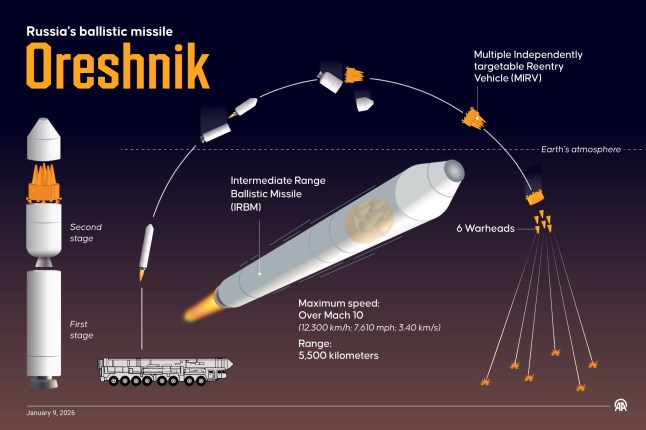
Details of how many Oreshnik missiles Putin’s army has are closely guarded.
Known as ‘Hazel shrub’ in Russian, the first batch of missiles is thought to have been delivered to the army in August.
Putin has boasted that Oreshnik missiles can travel at 10 times the speed of sound and claimed they could not be stopped mid-air.
To view this video please enable JavaScript, and consider upgrading to a web
browser that
supports HTML5
video
While the current missiles are loaded with six conventional warheads capable of targeting an independent target each, Oreshnik is thought to be powerful enough to carry nuclear arms. This makes it an ideal tool for nuclear intimidation, sending a threatening message from Kremlin to Nato.
What is the reaction to the missile attack?
Ukraine’s security services said they are treating the Oreshnik strike in Lviv as a war crime as it targeted critical infrastructure near the country’s EU border and in worsening weather conditions.
Ukraine’s foreign minister, Andrii Sybiha, said: ‘Such a strike close to EU and Nato border is a grave threat to the security on the European continent and a test for the transatlantic community.’
Meanwhile, Kaja Kallas, the EU’s Estonian foreign policy chief, said on X: ‘Putin doesn’t want peace, Russia’s reply to diplomacy is more missiles and destruction. This deadly pattern of recurring major Russian strikes will repeat itself until we help Ukraine break it.’
Get in touch with our news team by emailing us at webnews@metro.co.uk.
For more stories like this, check our news page.
